
What Is Karak Tea? The UAE's Everyday Cup Explained

There is a drink that runs through the entire UAE day. It is poured at petrol stations at 7am, carried into offices mid-morning, ordered after lunch, and handed to guests when they sit down in a majlis. It comes in a small cup, it is strong, sweet and milky, and it costs very little. It is karak.
For anyone trying to understand daily life in the Emirates, karak explains more than almost any other single item on a menu. Here is what it is, how it got here, and how to drink it properly.

What Is Karak Tea?
Karak is strong black tea brewed with milk, sugar and cardamom, simmered together rather than steeped separately. The result is thicker and creamier than ordinary tea, deeply aromatic, and served hot in a small cup — built for a quick, hot pour and a few sips rather than a long, slow drink.
The classic build is deliberately minimal: black tea, evaporated milk, cardamom, sugar. Some versions add saffron, ginger, cinnamon or cloves, but the restraint is part of what makes karak what it is.
Where the Name Comes From
Karak comes from the Hindi and Urdu word kadak, meaning strong. Chai simply means tea. Put together, karak chai is "the strong cup" — an accurate description of both the brew and the reason people drink it.
How Karak Arrived in the UAE
Karak is not originally Emirati, and its story is more interesting for that. It arrived with South Asian migration during the 1960s and 70s, brought by communities who had grown up on spiced milk tea and who opened the small cafeterias that still line UAE streets today.
The recipe adapted as it settled. Fewer spices, more sweetness, and a stronger brew to suit local preferences. Cardamom already held a firm place in Arabic cooking and coffee, which made the drink feel immediately familiar rather than foreign.
By the 1990s and 2000s, karak was no longer a migrant drink. It had become part of the fabric of daily life across every community in the country — one of the few things in the UAE that genuinely everyone shares.
Why Evaporated Milk Matters
This is the detail that separates Gulf karak from Indian chai. Evaporated milk was originally a practical choice: it stored well in a hot climate at a time when refrigeration was scarce. Canned milk simply worked better than fresh.
What began as necessity became the signature. Evaporated milk gives karak its particular density and slight caramelised sweetness — a texture fresh milk does not reproduce. Ask anyone who drinks karak daily and they will tell you the difference immediately.
Karak and Arabic Coffee Are Not the Same Thing
Visitors often use the two interchangeably. They are quite different, and both matter in Emirati hospitality.
Gahwa (Arabic coffee) is pale, unsweetened, lightly spiced with cardamom and sometimes saffron, and served in small handleless cups. It is the formal gesture of welcome, traditionally offered with dates.
Karak is dark, milky and sweet, served in a glass or small cup. It is the everyday cup — informal, constant, ordered without ceremony.
A traditional Emirati welcome usually involves gahwa and dates. Karak is what you drink for the rest of the day.
What to Eat With Karak
Karak is rarely a solo act. It works with almost anything, but a few pairings are close to standard in the UAE:
Chebab — Emirati pancakes, often at breakfast
Balaleet — sweet vermicelli with egg
Regag or paratha, torn and dipped
Dates and nuts
Luqaimat, where the spiced tea cuts through the date syrup
Where to Drink Karak in the UAE
Karak is genuinely everywhere in the Emirates, from roadside kiosks to drive-through windows. Drinking it in a traditional setting, though, gives it context — the tea alongside the food and surroundings it belongs to.
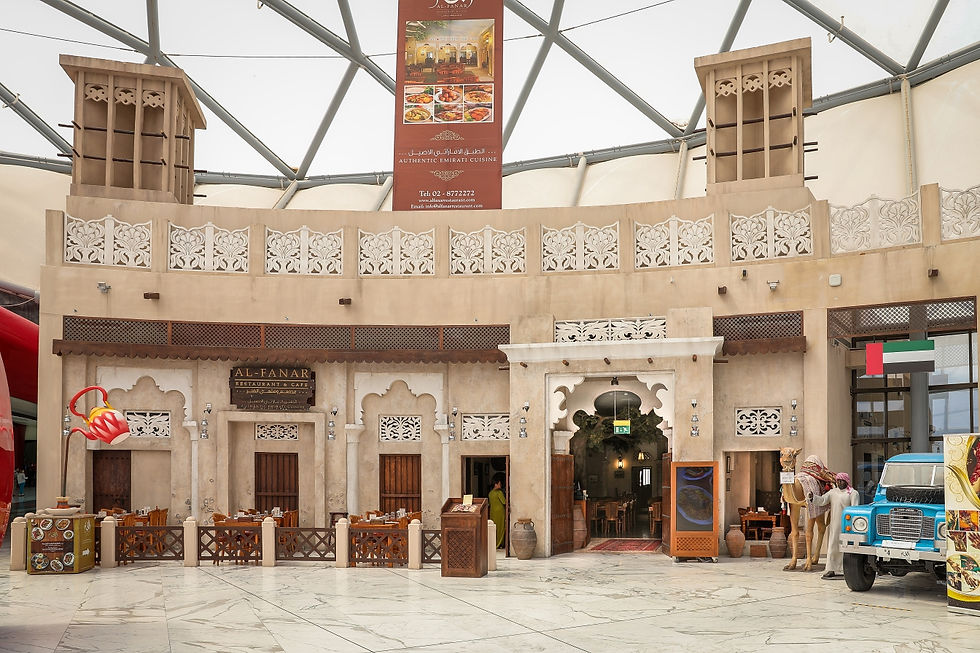
Al Fanar Restaurant & Café serves karak at every branch, alongside Arabic coffee and a full Emirati menu, in interiors built to recall the UAE of the 1960s. You will find us at:
Dubai Festival City, Dubai
Al Seef, Dubai — selected in the MICHELIN Guide
Al Barsha, Dubai
Yas Mall, Abu Dhabi
Al Ain
Karak also appears in our Emirati breakfast, served daily until midday. If you are new to the cuisine, our guide to authentic Emirati food for first-time visitors is a good place to start, and there is a companion piece on where to eat Emirati food in Abu Dhabi if you are visiting the capital.
Frequently Asked Questions
Does karak contain caffeine?
Yes. It is made with strong black tea, so it contains caffeine.
How is karak served?
Hot, in a small cup or glass, already sweetened. It is not usually served with milk or sugar on the side — it is brewed as one.
Try It Where It Belongs
A cup of karak is the smallest, easiest introduction to life in the Emirates. Visit any Al Fanar branch to try it with a traditional Emirati meal, or see the full menu before your visit.


Comments