
What Is Luqaimat? Dubai's Iconic Emirati Dessert

Ask almost anyone in the UAE to name one Emirati dessert and you tend to get the same answer: luqaimat. Golden and crisp on the outside, light and airy in the middle, glossy with date syrup — they turn up at iftar tables, wedding buffets, National Day gatherings and ordinary family evenings across the country.
If you are visiting the UAE and want to understand Emirati food beyond the main course, this is the dish to start with. Here is what luqaimat actually is, where it came from, and how to enjoy it the way people here do.

What Is Luqaimat?
Luqaimat are small balls of yeasted dough, deep-fried until deep gold and then coated in date syrup — known locally as dibs — or honey. Many versions are finished with toasted sesame seeds, and cardamom or saffron is often worked into the batter.
The texture is the whole point. A thin, crisp shell gives way to a soft, almost hollow centre, and the syrup soaks just far enough in to sweeten without turning the dough heavy. They are served warm, usually in a shared bowl, and they are meant to be eaten with your fingers.
What the Name Means
Luqaimat comes from the Arabic luqma, meaning a bite or a mouthful. Luqaimat is the diminutive — literally "little bites", which is exactly what they are.
The dessert carries an older name too: luqmat al-qadi, "the judge's morsel". The story goes that these fried sweets were so persuasive they could sway a judge's ruling — a nice piece of folklore that has followed the dish for centuries.
Where Luqaimat Comes From
The precise origin is debated. Similar honey-glazed fried dough appears in medieval Arabic cookbooks, with many food historians pointing to 13th-century Baghdad. Others trace the family tree through Greek and Turkish fried-dough traditions that spread across the region through centuries of trade.
What is not in question is how completely the UAE has made the dish its own. As a historic trading coast, the Emirates absorbed ingredients and ideas from every direction — and luqaimat, finished with local date syrup, is one of the clearest results.
Luqaimat, Legaimat, Lgeimat — Same Dessert
You will see the name spelled several ways in the UAE: luqaimat, legaimat, lgeimat, luqaymat. Arabic does not map neatly onto the Latin alphabet, so transliterations vary from one menu to the next. They all refer to the same thing.
At Al Fanar, it appears on the menu as legaimat — so if you are scanning for it, that is the spelling to look for.
When Emiratis Eat Luqaimat
Luqaimat is a celebration dessert more than an everyday one, though you will find it year-round in restaurants. It appears most often at:
Ramadan iftar, after the fast is broken
Eid al-Fitr and Eid al-Adha gatherings
Weddings and large family occasions
UAE National Day celebrations
Majlis gatherings, served alongside coffee
In many households the recipe is closely held — a particular syrup, a specific frying technique, a pinch of saffron passed down through a family. Part of the pleasure of eating luqaimat in the UAE is that no two versions are quite identical.
How It Compares to Loukoumades, Lokma and Awamat
Fried dough is close to universal, and luqaimat has relatives across the region:
Loukoumades in Greece, usually with honey and cinnamon
Lokma in Turkey, drizzled with sugar syrup
Awamat across the Levant, often with orange blossom or rose water
They share an ancestor without sharing an identity. What defines the Emirati version is date syrup — a deeper, more caramelised sweetness than honey — plus the cardamom and saffron notes in the dough, and the sesame finish.
How to Eat Luqaimat Like a Local
Three things worth knowing. Eat them warm — the contrast between crisp shell and soft centre fades as they cool. Order them to share; a bowl in the middle of the table is the correct format. And pair them with something hot and unsweetened to balance the syrup.
Traditionally that means gahwa — Arabic coffee, lightly spiced with cardamom and served in small cups. Karak tea is the other natural match, and the one you will see most often on tables across the UAE.
Where to Try Luqaimat in the UAE
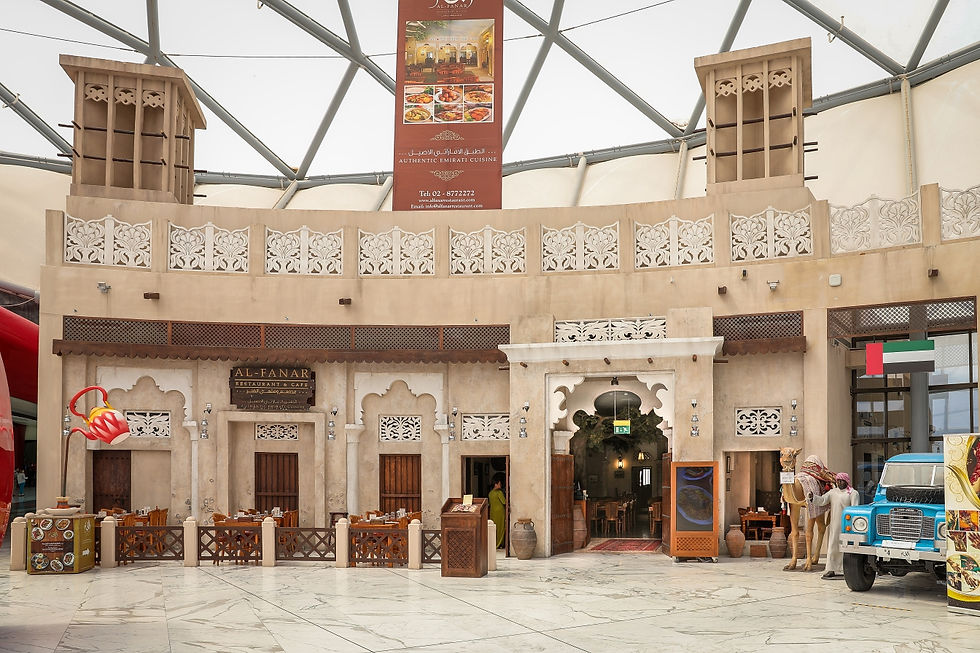
Al Fanar Restaurant & Café serves legaimat at every branch, prepared the traditional way and served warm with date syrup. Alongside the classic version, the menu includes chocolate and pistachio variations for anyone who wants to try something different.
You will find us at:
Dubai Festival City, Dubai
Al Seef, Dubai — selected in the MICHELIN Guide
Al Barsha, Dubai
Yas Mall, Abu Dhabi
Al Ain
Luqaimat sits at the end of a proper Emirati meal, after machboos, thareed or grilled seafood. If you are planning a first visit, our guide to what to expect at an Emirati restaurant walks through the full experience, and our overview of what is usually ordered at the table explains how the sharing format works.
Frequently Asked Questions
Is luqaimat only eaten during Ramadan?
No. Luqaimat is strongly associated with Ramadan and Eid, but it is served year-round in Emirati restaurants and made at home for all kinds of occasions.
What is luqaimat made of?
A simple yeasted batter — flour, sugar, yeast and water, often with cardamom or saffron — deep-fried and then coated in date syrup or honey, usually with sesame seeds on top.
Is luqaimat the same as loukoumades?
They are close relatives, not the same dish. Loukoumades are Greek and typically finished with honey and cinnamon; Emirati luqaimat is defined by date syrup and its cardamom and saffron aromatics.
How do you pronounce luqaimat?
Roughly loo-QAY-mat. In the Emirati dialect it is often closer to lgeimat, which is why you will see that spelling on some menus.
Come and Try It
Luqaimat is the easiest possible introduction to Emirati sweets — familiar enough to be immediately likeable, distinct enough to be memorable. Visit any Al Fanar branch to try it fresh, or explore the full menu before you come.


Comments